c. 756 BC
Foundation of Sinope (Sinop)
Seafarers from the Ionian city-state of Miletus establish Sinope on the southern Black Sea coast, making it one of the first and most important Greek colonies in the region. The traditional date of c. 756 BC is widely cited, though archaeological evidence points to firm settlement by the late 7th century BC (c. 630 BC). Sinope became the mother-colony from which daughter cities would spring across the Pontic coast.
c. 756 BC
Foundation of Trapezus (Trabzon)
Settlers from Sinope push eastward and found Trapezus, perched on steep coastal cliffs above the Black Sea. Named for its "table-like" plateau (trapeza in Greek), the settlement commands trade routes reaching deep into the Caucasus and Mesopotamia. It will remain a center of Pontic Greek life for over 2,700 years.
c. 7th–6th Century BC
The Milesian Network Expands
Additional colonies are planted along the coast: Amisos (Samsun), Kerasounta (Giresun — famous as the city that gave the cherry, kerasion, its name to the world), Kotyora (Ordu), and dozens more. These cities form a vast trading network, exporting iron, timber, silver, hazelnuts, and grain across the Mediterranean. The Greek settlers interact extensively with indigenous peoples — the Chalybes (master iron-workers), Mossynoeci, Macrones, and Colchians.
c. 401 BC
Xenophon and the Ten Thousand Reach Trapezus
The Athenian soldier-historian Xenophon leads 10,000 Greek mercenaries through the highlands of eastern Anatolia. After months of brutal retreat from Persia, the soldiers crest the Pontic mountain passes and catch their first sight of the sea. Their legendary cry — "Thálassa! Thálassa!" ("The Sea! The Sea!") — was shouted upon sighting the Black Sea near Trapezus. The moment immortalized the Pontic coast in Western literature.
"Thálassa! Thálassa!"
Xenophon's Anabasis records the famous march of the Ten Thousand. When the exhausted Greek soldiers saw the Black Sea from the Pontic highlands, they knew they were within reach of friendly Greek cities. The cry "The Sea! The Sea!" has echoed through Western literature for over 2,400 years — a powerful symbol of homecoming and survival.
334–323 BC
Alexander the Great and the Hellenistic Period
Alexander the Great's conquests reshape the eastern Mediterranean. While Pontus is not directly subjugated, the collapse of the Persian Empire and the subsequent wars of the Diadochi (Alexander's successors) create the political chaos from which the Kingdom of Pontus will emerge.
302 BC
Mithridates of Cius Assassinated
Mithridates of Cius, a Persian nobleman with Achaemenid royal blood, is killed during the turmoil of the Successor Wars. His young son flees into the Pontic interior with a handful of loyal followers.
281 BC
Foundation of the Kingdom of Pontus
Mithridates I Ktistes ("The Founder") establishes the independent Kingdom of Pontus in the highlands of northern Anatolia. The new kingdom blends Persian dynastic tradition with Hellenistic Greek culture — its official language is Koine Greek, its religion embraces both Olympian and Persian deities, and its court mirrors the sophistication of the Hellenistic world.
c. 183 BC
Capture of Sinope — The New Capital
Pharnaces I conquers the wealthy maritime city of Sinope and makes it the royal capital. With control of the greatest port on the southern Black Sea, the kingdom now commands lucrative trade routes connecting the Mediterranean, the Caucasus, and the Eurasian Steppe.
120 BC
Rise of Mithridates VI Eupator — "The Great"
Mithridates VI ascends to the throne as a young man, reportedly after surviving assassination attempts by his own mother during a contested regency. A polyglot said to speak 22 languages, he sets about transforming Pontus into a Black Sea superpower, extending his rule into Colchis (modern Georgia), the Crimean Peninsula (the Bosporan Kingdom), Lesser Armenia, and much of Asia Minor.
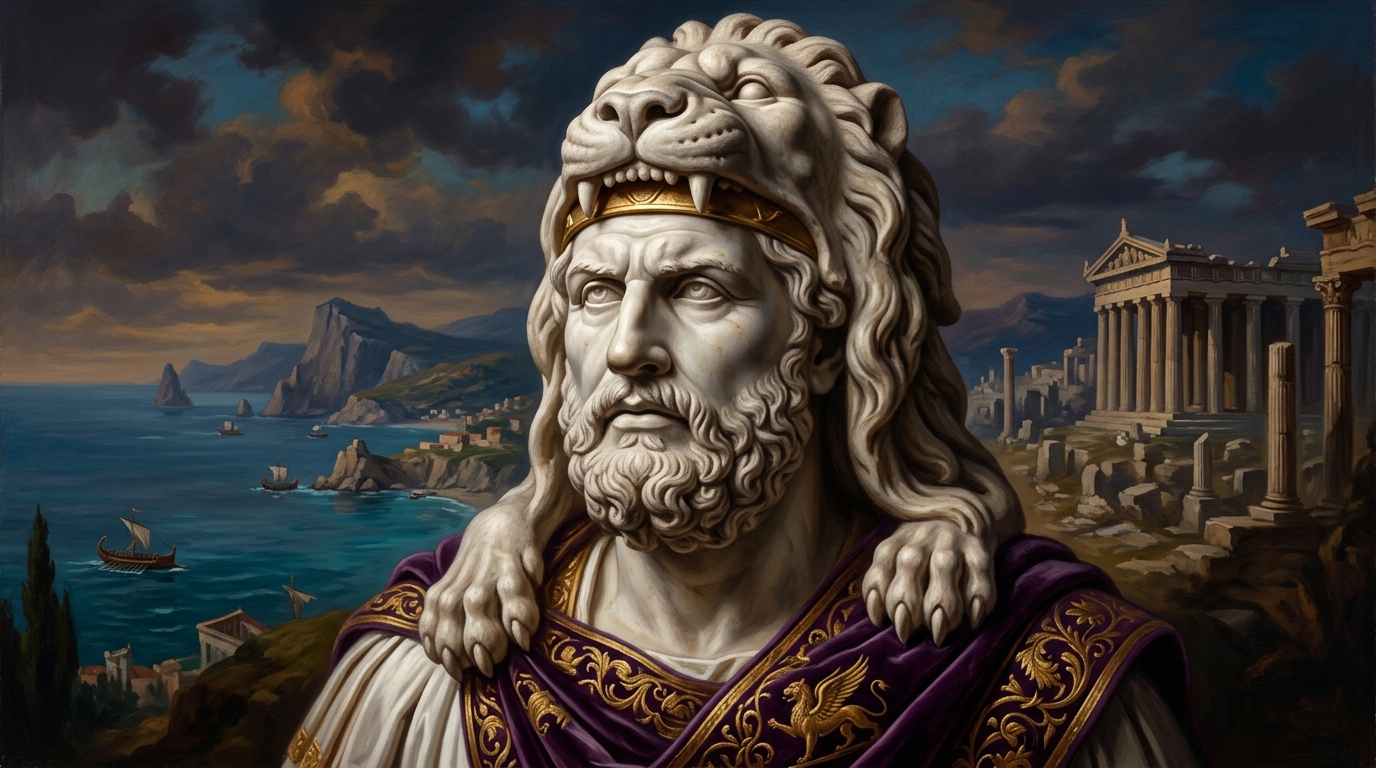
Artistic portrait of Mithridates VI Eupator, "The Great" — Rome's most feared eastern adversary.
89–85 BC
The First Mithridatic War
Mithridates invades the Roman province of Asia. In a coordinated strike, he orders the Asiatic Vespers — the slaughter of approximately 80,000 Roman and Italian civilians across Asia Minor in a single day. Rome responds by sending the generals Sulla and Fimbria. After initial Pontic successes, Sulla forces a peace treaty at Dardanos (85 BC), but the conflict is far from over.
83–81 BC
The Second Mithridatic War
A shorter conflict instigated by the Roman general Murena, who invades Pontus without authorization. Mithridates repels the attack and emerges victorious — a rare feat against Roman arms.
74–63 BC
The Third Mithridatic War & the Fall of Pontus
Rome sends its finest commanders — first Lucullus, then Pompey the Great — to finally destroy the Pontic kingdom. After years of guerrilla resistance, Mithridates retreats to the Crimea. Betrayed by his own son Pharnaces II, and unable to kill himself with poison due to his legendary immunity, Mithridates orders a bodyguard to strike him down with a sword in 63 BC.
Mithridatism: The Poison King's Legacy
Mithridates VI's lifelong obsession with poisons gave his name to a medical concept that endures to this day: mithridatism — the practice of building tolerance to a poison through gradual self-administration of sub-lethal doses. His legendary "universal antidote," the Mithridatium, was said to contain over 50 ingredients and was reproduced by Roman physicians for centuries. While modern toxicology has largely debunked the viability of blanket poison immunity (most chemical toxins accumulate rather than immunize), the principle of controlled exposure lives on in allergy desensitization therapy and anti-venom production.
63 BC
Pontus Becomes a Roman Province
Pompey the Great reorganizes the former kingdom as the Roman province of Bithynia et Pontus. Parts of the eastern kingdom continue as client states under Pontic dynasts until full absorption into the empire by 62/63 AD. The Greek cities of the coast thrive under Roman rule, and the region becomes an early center of Christianity.
1st–4th Century AD
Christianity Takes Root in Pontus
The Apostle Andrew is traditionally credited with bringing Christianity to the Black Sea coast. The First Epistle of Peter is addressed partly to believers "in Pontus." By the 4th century, the region has become a stronghold of Orthodox Christianity, producing influential Church fathers and bishops.
330 AD
Constantinople Founded — Pontus in the Eastern Roman Empire
Emperor Constantine the Great refounds Byzantium as Constantinople, the new capital of the Roman Empire. The Pontic coast becomes an integral part of the Eastern Roman (Byzantine) Empire, supplying grain, soldiers, and naval resources to the imperial capital.
6th–10th Century
Pontus as a Byzantine Frontier
The region serves as a vital military and economic zone. The theme of Chaldia (centered on Trebizond) becomes one of the empire's most strategically important military-administrative units, guarding the eastern frontier against Arab and later Seljuk Turkish incursions. Fortresses, churches, and monasteries proliferate across the Pontic Alps. The Panagia Soumela Monastery (founded 386 AD) becomes one of the most revered pilgrimage sites in Eastern Christendom.
1057–1059
Isaac I Komnenos — First Komnenos Emperor
Isaac I Komnenos, a military aristocrat with roots in Paphlagonia and the broader Black Sea region, seizes the Byzantine throne. Though his reign is brief, he establishes the Komnenos family as a major imperial dynasty and begins a pattern of Pontic-connected families shaping the empire's destiny.
1081–1185
The Komnenian Restoration: A Byzantine Golden Age
Five Komnenos emperors — Alexios I (1081–1118), John II (1118–1143), Manuel I (1143–1180), Alexios II (1180–1183), and Andronikos I (1183–1185) — rule from Constantinople in an era known as the Komnenian Restoration. Alexios I navigates the First Crusade with remarkable diplomacy; John II is hailed by contemporaries as the finest emperor of his century; Manuel I projects Byzantine power into Italy, Hungary, and the Holy Land. These rulers collectively represent one of the most culturally productive and militarily successful periods in Byzantine history.
The Komnenos Connection to Pontus
The Komnenos family originated in Paphlagonia, a region on the Black Sea coast adjacent to Pontus proper. Their ancestral estates lay in northern Asia Minor, and they maintained deep ties to the Pontic region. When Constantinople fell to the Fourth Crusade in 1204, it was to their Pontic homeland that the family retreated — establishing the Empire of Trebizond and returning the seat of Greek imperial power to the Black Sea shores where their ancestors had risen to prominence.
1204
The Fourth Crusade Sacks Constantinople
Western Crusaders divert their campaign and sack Constantinople, ending the Byzantine Empire as a unified state. Three Greek successor states emerge from the wreckage: the Empire of Nicaea, the Despotate of Epirus, and — in the Pontic homeland — the Empire of Trebizond.
1204
Foundation of the Empire of Trebizond
With military support from Queen Tamar of Georgia, brothers Alexios I and David Komnenos — grandsons of the deposed emperor Andronikos I — seize Trebizond and establish the Empire of Trebizond. Its rulers style themselves Megas Komnenos (Grand Komnenos) and claim the legitimate succession to the Roman/Byzantine throne.
1204–1461
Trebizond: The Last Greek Empire
For 257 years, the Empire of Trebizond survives as a narrow but wealthy state along the southeastern Black Sea. Sitting at the western terminus of the Silk Road, it grows fabulously rich from the trade in silk, spices, and precious metals flowing between Persia, Central Asia, and Europe. The Trapezuntine court becomes a beacon of Greek learning, art, and literary culture. The empire navigates a precarious existence through strategic marriages, diplomacy with the Mongol Empire, and careful tributary relationships with neighboring Islamic powers.
August 15, 1461
Fall of Trebizond — End of the Last Greek Empire
Ottoman Sultan Mehmed II, conqueror of Constantinople eight years earlier, besieges Trebizond. Emperor David Komnenos surrenders the city to spare its population, ending the last independent Greek state of the medieval world. Trebizond had outlived even the restored Byzantine Empire in Constantinople by eight years, making it the final political expression of the ancient Greek and Roman imperial tradition.
1461–1900s
Pontic Greeks Under Ottoman Rule
Under the Ottoman millet system, the Pontic Greeks maintain a degree of communal autonomy. They preserve their language, Orthodox faith, and cultural traditions for centuries. Coastal cities like Trabzon and Samsun continue as commercial centers, while mountain communities in the Pontic Alps remain deeply traditional, speaking the Pontic Greek dialect largely unchanged since antiquity. The crypto-Christian communities of the Of valley practice their faith in secret.
1908
The Young Turk Revolution
The Young Turks seize power in the Ottoman Empire, initially promising constitutional reform. But their ideology of Turkish ethno-nationalism soon leads to the systematic targeting of Christian minorities — Greeks, Armenians, and Assyrians — viewed as threats to a homogeneous Turkish state.
1914–1918
World War I: Labor Battalions & Death Marches
With the outbreak of World War I, the genocide intensifies. Greek men aged 18 to 50 are conscripted into Amele Taburlari (labor battalions) — forced-labor units where thousands perish from exposure, starvation, and execution. Simultaneously, entire Greek villages are subjected to forced deportations into the Anatolian interior. Women, children, and the elderly are driven on death marches through harsh terrain without food or water.
A Shared Genocide
The Pontic Greek Genocide (1914–1923) was part of the Ottoman Empire's broader campaign of ethnic cleansing against its indigenous Christian populations. Alongside the Armenian Genocide and the Assyrian Genocide, it represents one of the most devastating episodes of the 20th century. Estimates suggest that between 300,000 and 360,000 Pontic Greeks were killed, with many more displaced. The International Association of Genocide Scholars has recognized these events as genocide.
May 19, 1919
Mustafa Kemal Lands at Samsun
Mustafa Kemal (Atatürk) arrives in Samsun to organize Turkish nationalist resistance. His arrival marks the beginning of the Turkish War of Independence. May 19 is today commemorated by the Pontic Greek diaspora as the Pontic Greek Genocide Remembrance Day.
1919–1922
The Greco-Turkish War
Greece attempts to claim territories in western Anatolia promised by the Treaty of Sèvres. The war ends in Greek military defeat and the Great Fire of Smyrna (September 1922), which destroys the Greek and Armenian quarters of the city and forces the mass evacuation of hundreds of thousands of refugees.
July 24, 1923
The Treaty of Lausanne & the Population Exchange
The Treaty of Lausanne between Greece and the new Republic of Turkey mandates a compulsory population exchange based on religion. Approximately 1.2 million Orthodox Christians are deported from Turkey to Greece, and around 400,000 Muslims from Greece to Turkey. For the Pontic Greeks, this represents the final, definitive severing from a homeland they had inhabited continuously for nearly 3,000 years.
1923–1930s
Refugees Rebuild in Greece
Hundreds of thousands of Pontic Greek refugees arrive in Greece — many to the region of Macedonia, and particularly the outskirts of Thessaloniki. Destitute and traumatized, they face discrimination from local populations who view them as foreigners. Despite this, they build new communities, found cultural associations, and fiercely preserve their Pontic dialect, music, and dances.
1940s–1960s
Migration to the New World
Waves of Pontic Greek families emigrate to the United States, Canada, and Australia, establishing diaspora communities in cities like New York, Chicago, Cleveland, Toronto, and Melbourne. Cultural associations and Pontian societies are founded to maintain heritage, language, and communal bonds.
1988–2000s
Pontic Greeks from the Soviet Union Return to Greece
The collapse of the Soviet Union triggers a massive wave of Pontic Greek repatriation from Georgia, Russia, Kazakhstan, and other former Soviet states. These communities — descendants of Pontic Greeks who had migrated to the Russian Empire and later the USSR — bring with them preserved traditions, Pontic dialect variants, and a living link to the ancestral homeland.
May 19 — Annually
Pontic Greek Genocide Remembrance Day
Every year on May 19th, Pontic Greek communities worldwide hold commemorations, memorial services, and cultural events to honor the victims of the genocide and ensure that the history of Pontos is neither forgotten nor silenced. The day serves as both a solemn remembrance and a celebration of cultural survival.
21st Century
A Living Heritage
Today, the Pontic Greek diaspora numbers in the millions across Greece, the United States, Canada, Australia, Germany, and the nations of the former Soviet Union. Organizations like the Pan-Pontian Federation of the USA & Canada, the Pontian Greek Society of Chicago, and scores of local associations keep the Pontic dialect, the kementzes (Pontic lyra), the Serra and Kotsari dances, and the memory of ancestral Pontos alive for new generations.